> For the complete documentation index, see [llms.txt](https://docs.secured.finance/llms.txt). Markdown versions of documentation pages are available by appending `.md` to page URLs; this page is available as [Markdown](https://docs.secured.finance/fixed-rate-lending/core-concepts/fixed-maturity-and-auto-roll.md).
# Fixed Maturity & Auto-Roll
Quarterly markets, and exactly what happens to your position at maturity
## Quarterly markets
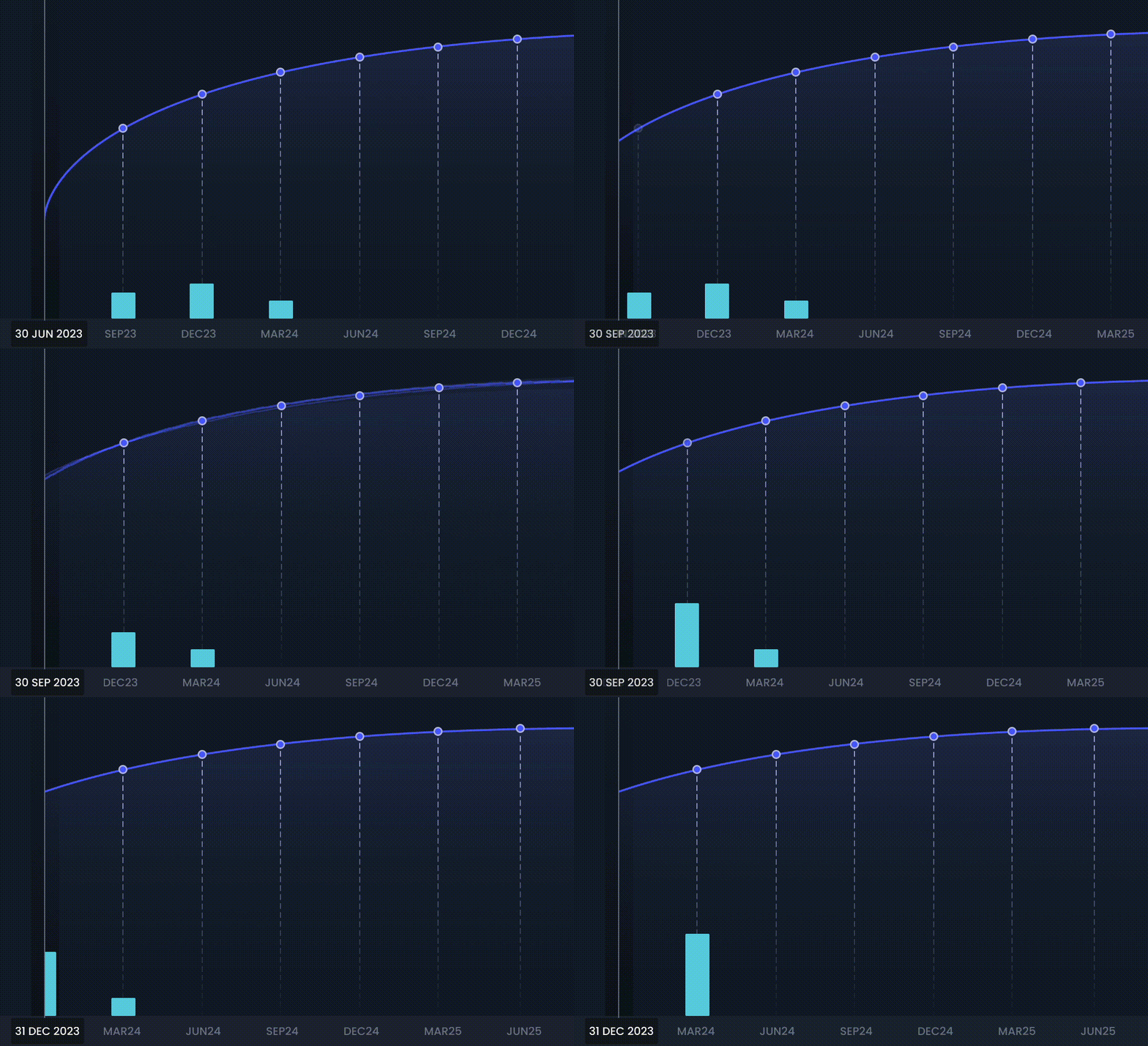
Each currency trades in up to **eight order books** at once, with maturities from 3 months to 2 years spaced 3 months apart. Eight is the standard full set; depending on liquidity, a market may offer fewer maturities (the app shows what is currently open). Maturity falls on the **last Friday of March, June, September, and December**, aligning with listed futures conventions so rates are easy to reference and hedge.
Markets are named by contract month: **DEC2026** matures on the last Friday of December 2026.
Standardized maturities concentrate liquidity: instead of fragmenting orders across arbitrary dates, everyone trades the same eight points on the curve — which is also what makes a readable [yield curve](/fixed-rate-lending/getting-started/platform-guide/markets.md) possible.
Fixed Maturity Standard of 8 distinct order books ranging from 3 months to 2 years
## The quarterly cycle
When the nearest market matures, three things happen at once:
1. The maturing order book is **deactivated** and recycled.
2. A **new 2-year order book** opens via the [Itayose](/fixed-rate-lending/advanced-topics/itayose.md) opening auction (pre-orders accepted for 7 days prior).
3. All positions in the matured market **Auto-Roll** into the nearest 3-month market.
Technical details of the rotation: [Orderbook Rotation](/fixed-rate-lending/advanced-topics/orderbook-deep-dive/orderbook-rotation.md).
## Auto-Roll
{% hint style="warning" %}
**Auto-Roll is protocol-wide.** Every matured position rolls automatically into the nearest 3-month market — it cannot be enabled, disabled, or configured per user. The protocol has **no automatic settlement**: to get funds back, [unwind](/fixed-rate-lending/getting-started/managing-positions.md) your position manually (possible before or after maturity).
{% endhint %}
Auto-Roll moves an open position into the nearest 3-month order book at maturity
### Why Auto-Roll exists
* **No reinvestment gap** — in traditional fixed income, a matured bond sits idle until you reinvest. Auto-Roll keeps capital working at a fair, close-to-mid price.
* **No counterparty hunt** — you don't need to find a new match on the order book at maturity.
* **Gas efficiency** — the roll is computed lazily via [Genesis Value accounting](/fixed-rate-lending/advanced-topics/orderbook-deep-dive/genesis-value-and-compound-factor.md), not per-position transactions.
### What it costs
Each roll charges the auto-roll fee (same rate as the taker fee, prorated — see [Fees](/fixed-rate-lending/core-concepts/fees.md)), embedded in the roll price. The roll price itself is determined by a transparent waterfall — see [Auto-Roll Price Discovery](/fixed-rate-lending/core-concepts/fixed-maturity-and-auto-roll/auto-roll-price-discovery.md).
### Worked example
1. In January, Alice lends 1,000 USDC in the MAR2027 market (3-month maturity).
2. On the last Friday of March, MAR2027 matures. Alice does nothing.
3. Her position rolls into **JUN2027** — now the nearest 3-month market — at the auto-roll price, minus the roll fee.
4. If Alice wants her USDC instead, she unwinds the JUN2027 position (or unwinds before the March maturity) and withdraws.
## Your choices at maturity
| You want to… | Action |
| ------------------------------------ | ------------------------------------------------------------------------------------------------------ |
| Stay invested at the new market rate | Nothing — Auto-Roll continues each quarter |
| Exit | **Unwind** (before or after maturity), then withdraw |
| Choose a *different* maturity | Unwind, then place a new order in the market you prefer |
| Use the position elsewhere in DeFi | [Tokenize](/fixed-rate-lending/core-concepts/tokenization.md) it as an ERC-20 ZC Token before maturity |
## Related
* [Auto-Roll Price Discovery](/fixed-rate-lending/core-concepts/fixed-maturity-and-auto-roll/auto-roll-price-discovery.md) — how the roll price is set
* [Itayose](/fixed-rate-lending/advanced-topics/itayose.md) — how new markets open
* [Fees](/fixed-rate-lending/core-concepts/fees.md) — roll fee details